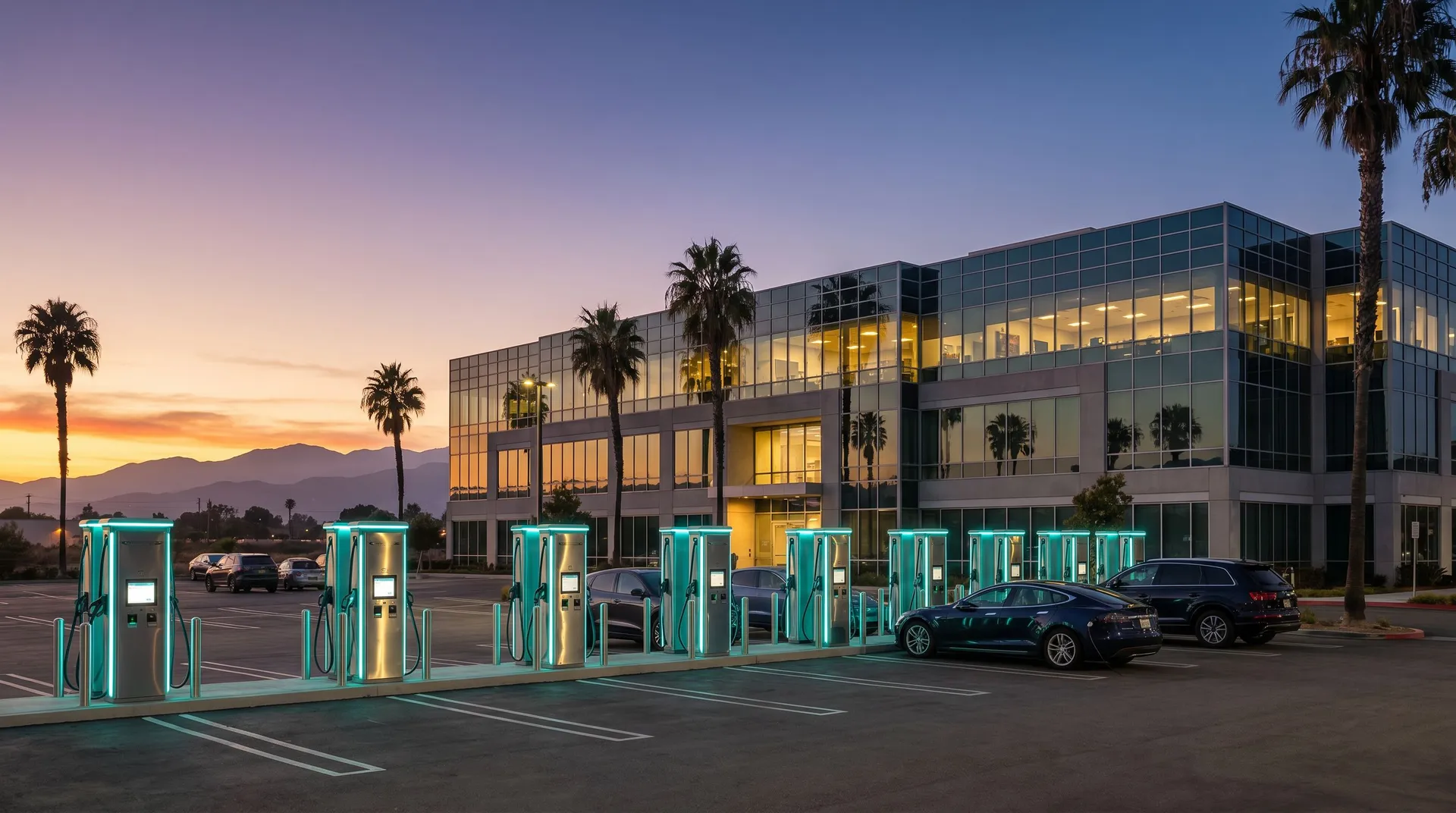
Commercial EV Charging
Thinking about adding EV charging to your property but not sure where to start? This is the overview: what commercial EV charging is, what it costs, what incentives pay for, how long it takes, and who keeps it running once it's live. We handle the entire process for you, from first call to commissioning and beyond.
What Commercial EV Charging Actually Is
Commercial EV charging means installing chargers at a business or multifamily property for tenants, employees, customers, or guests, rather than the single unit you'd put in a home garage. The big difference is scale and control. Commercial systems use heavier-duty hardware, tie directly into your building's electrical service, and run on software that manages who can charge, what they pay, and how power is shared across the site.
There are two main types. Level 2 chargers run on 240 volts and add roughly 25 to 40 miles of range per hour, which is the right fit for anywhere vehicles park for a couple of hours or more: apartments, offices, hotels, and retail. DC fast charging delivers a much faster charge, 20 to 45 minutes for most vehicles, and suits high-traffic sites where drivers need to top up and go.
What makes it "commercial" is everything around the charger: smart charging that balances load so you don't have to upsize your panel, network management that tracks usage and uptime, and billing so you can recover costs or earn revenue. Get those pieces right and a few parking stalls turn into a managed amenity that pays for itself.
Have a specific property in mind? Talk to a commercial EV charging expert →
Who Needs It, and Why Now
Here's the part most owners underestimate: not having EV charging is already costing them. California has the highest EV adoption in the country, and renters and guests increasingly pick the property that lets them charge over the one that doesn't. That's lost leases and lost bookings happening quietly, before anyone runs the numbers on installing.
The regulatory side is pushing the same direction. California now requires EV-ready infrastructure in many new commercial and multifamily builds, and the incentive stack that pays for retrofits is as strong right now as it has ever been. Add the upside, higher property value, longer dwell times, a real rent premium in multifamily, and charging revenue you keep, and the question shifts from "should we?" to "how soon, and what does it cost?"
If you own or manage an apartment community, a shopping center, a parking facility, a hotel, an office, or a fleet yard, this is squarely for you. The right answer depends on your property, which is exactly what a free site assessment is for.
The Properties We Serve
Apartment Communities
Residents charge overnight and wake up full. 34% of renters won't sign without EV charging, and SCE Charge Ready covers the make-ready cost.
Learn more → RETAILShopping Centers & Retail
Customers dwell two to six hours. Level 2 charging adds real range during a visit, increasing dwell time and repeat traffic.
Learn more → PARKINGParking Structures & Lots
High utilization, 24/7. Load management lets you deploy more ports than raw panel capacity would normally allow.
Learn more → HOSPITALITYHotels & Hospitality
EV charging is now a booking filter. Guests choose properties where they can charge, and stay longer when they do.
Learn more →How the Process Works
The first thing owners and managers want to know is how long this takes and how much of it lands on their plate. The honest answer: most projects run 6 to 12 weeks, and almost none of the work is yours. We built the company specifically to take that weight off you, because the process can feel overwhelming when no one has walked you through it.
There are five stages. First, a free site assessment and electrical load study, where we figure out where chargers should go relative to your panels (the single biggest cost factor). Second, design and demand planning. Third, permits, which we file with your jurisdiction, plus SCE utility coordination. Fourth, installation: trenching, conduit, mounting, and wiring, usually 1 to 3 days on site. Fifth, commissioning and network setup, so the chargers come online ready to use.
Through all of it we are your single point of contact, and we keep you in the loop at every step so you never feel left in the dark. For the full breakdown of scope, timeline, and what's included, see our commercial EV charging installation page.
Who Owns the Chargers, and Who Keeps Them Running
A lot of property managers hesitate because they assume going ahead means becoming a charging company: running the hardware, fielding driver complaints, chasing down whatever breaks. It doesn't. You say yes, and we handle the rest. That's the whole point of working with us.
The chargers are yours, and so is the revenue they generate. What's on us is keeping them running: maintenance, the networking and software that sit behind every session, and uptime. We monitor the system so problems get caught and fixed before they cost you, which means no down days and no revenue quietly leaking out of a station nobody noticed was offline.
So you get the asset and the income, without the operational headache. That clear line, your chargers and revenue, our maintenance and uptime, is the answer to the question almost every owner asks: if something goes wrong, who fixes it? We do.
What It Costs, and What Incentives Cover
Cost is always the question owners circle back to, and the honest range is wide because it depends on your property. As a starting point, commercial Level 2 runs about $3,500 to $6,500 per port for straightforward jobs, more when a panel upgrade or long trench is involved, and DC fast charging runs much higher per port. The number that matters, though, is what's left after incentives, and for qualifying properties that figure is often a fraction of the sticker price.
We don't just point you to the programs. We work the state and federal incentives together to capture the maximum your property qualifies for, prepare the paperwork, and tell you how quickly the rebates come back so the timing is never a mystery. For a deep dive on numbers, read our guide on commercial EV charging installation cost, or model your own project with the free cost estimator.
SCE Charge Ready: Make-Ready Infrastructure
Covers 100% of make-ready costs: trenching, conduit, panel upgrades, and wiring to the charger location. This is usually the single largest line item, and Charge Ready can eliminate it for qualifying SCE-territory properties.
CALeVIP: Up to $3,500 Per Level 2 Charger
California's statewide rebate covers charger equipment, up to $3,500 per Level 2 unit. For a 10-port project, that's up to $35,000 back. DC fast charging projects can qualify for far more.
Federal 30C Tax Credit: 30% of What's Left
The Alternative Fuel Vehicle Refueling Property Credit covers 30% of equipment and installation costs, up to $100,000 per charger, applied after SCE and CALeVIP.
Ready to add EV charging to your property?
We handle everything: permits, utility coordination, incentive applications, installation, and ongoing maintenance.
Get started →Why Gorgen
EV charging is all we do. We don't treat it as a side line to general electrical work, which is the most common mistake we see: the wrong installer mounts a charger, hands you the keys, and disappears onto an unrelated job, leaving you to sort out incentives, networking, and what to do when something breaks. We go the other way. We walk you through the whole thing, prepare every incentive application, deliver a white-glove install from first call to commissioning, and stay on for maintenance and uptime.
The part owners tell us they value most is simple: we keep you informed. You always know where your project stands, where each rebate is in the pipeline, and what happens next, so you never feel left in the dust. EVITP certified, working under licensed C-10 electrical partners, and focused on one thing only: commercial Level 2 and DC fast charging done right. When you're ready for specifics, our installation page lays out the full scope.
Commercial EV Charging Questions
Want a number before we talk? Try our free cost estimator.
Commercial EV charging is the installation and operation of electric vehicle chargers at a business or multifamily property for use by tenants, employees, customers, or guests, rather than at a single-family home. In practice it means networked Level 2 chargers (240-volt units that add roughly 25 to 40 miles of range per hour) or DC fast chargers (high-power units that charge a vehicle in 20 to 45 minutes), paired with software that handles driver access, pricing, load management, and reporting. Because these systems serve many drivers and tie into a building's electrical service, they need commercial-grade hardware, permits, utility coordination, and a maintenance plan, all of which we handle for you.
Commercial Level 2 installation typically runs $3,500 to $6,500 per port for straightforward projects, and $8,000 to $18,000 or more per port when a panel upgrade, trenching, or a long conduit run is involved. DC fast charging runs $30,000 to $120,000 or more per port. Those are pre-incentive figures. SCE Charge Ready, CALeVIP, and the federal 30C tax credit reduce most qualifying projects substantially, sometimes close to zero out of pocket. You can model your own numbers with our free cost estimator, and we provide a written, line-item estimate after your free site assessment.
Qualifying commercial and multifamily properties in SCE territory can stack three programs: SCE Charge Ready, which covers 100% of make-ready infrastructure (trenching, conduit, panel upgrades, and wiring); CALeVIP, which rebates up to $3,500 per Level 2 charger; and the federal 30C tax credit, which covers 30% of equipment and installation, up to $100,000 per charger. We aim for the maximum your property qualifies for, prepare and template the applications, and keep you posted on where each rebate sits in the pipeline so you know exactly when the money comes back.
Most commercial projects take 6 to 12 weeks from signed contract to energized chargers: site assessment (about a week), permit application and review (2 to 4 weeks under California's AB 1236 timelines), materials procurement (1 to 2 weeks), installation (1 to 3 days for most sites), and final inspection plus utility interconnection (1 to 2 weeks). We manage the entire timeline and update you at every step, so you are never left wondering where things stand.
If you own or manage multifamily housing, retail, parking, hospitality, or other commercial property in California, the answer is increasingly yes. EV adoption is highest in California, and tenants and guests now choose properties where they can charge, which means not offering it is already costing you in lost leases and bookings. New construction codes require EV-ready infrastructure in many commercial and multifamily builds, and the incentive stack is at its strongest right now. The clearest way to know what your specific property needs is a free site assessment. You can also read our guide to commercial EV charging installation to see exactly how it works.
Ready to Add EV Charging to Your Property?
Tell us about your property and we'll schedule a free site assessment. No commitment required.
- Commercial-grade Level 2 and DC fast charger installation
- SCE Charge Ready eligible: $0 make-ready cost for qualifying properties
- Federal 30C tax credit covers 30% of installation costs
- Licensed C-10 Electrical Partners, EVITP certified, fully insured
- Serving all of Riverside and San Bernardino Counties